
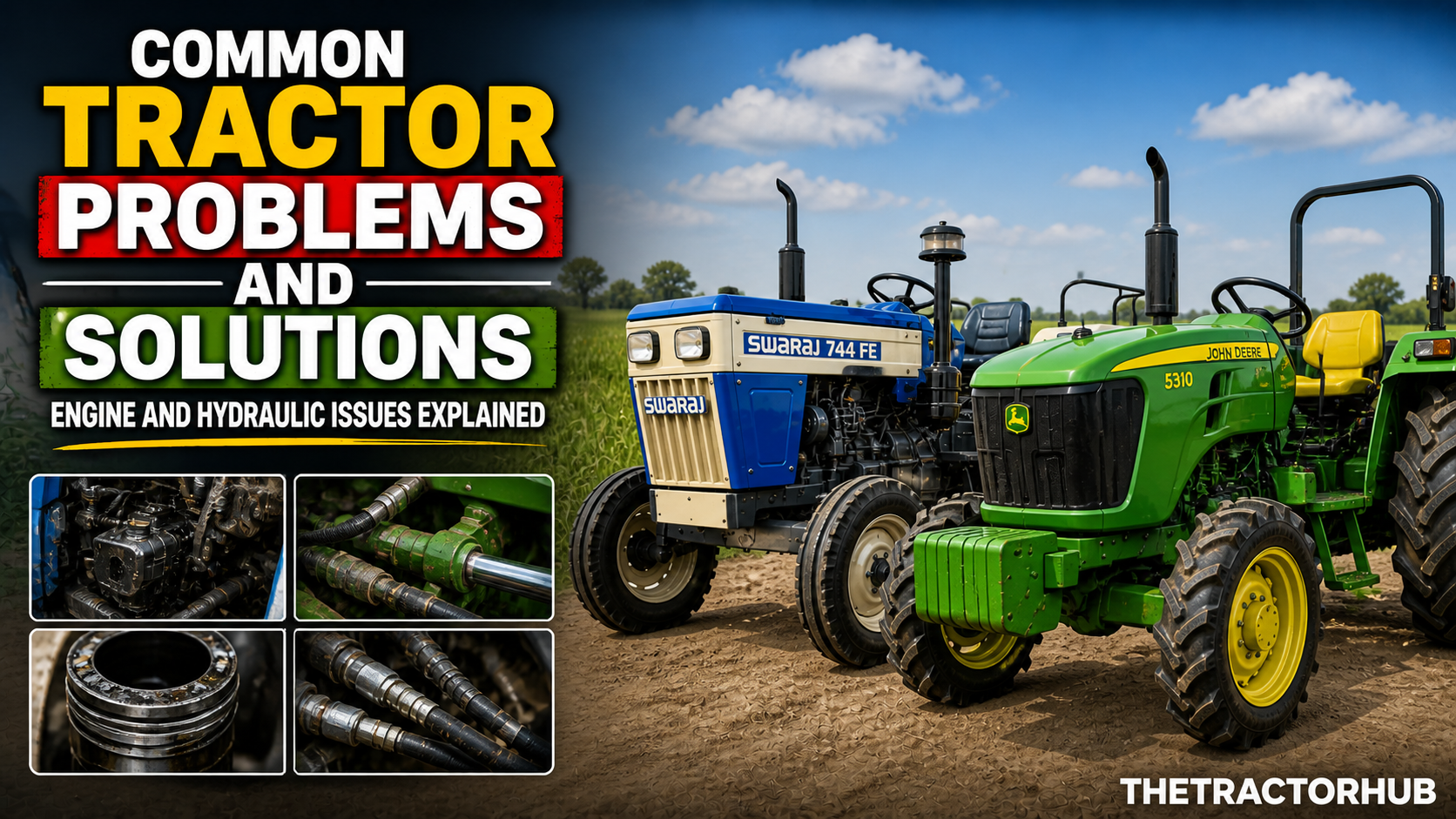
Common Tractor Engine Problems and Solutions
Every tractor owner in India has faced engine or hydraulic problems at some point. Whether your tractor will not start, is overheating, producing unusual smoke, or the hydraulic lift is responding slowly — understanding the root cause can save you significant time and expensive repair bills.
This comprehensive guide covers the most common tractor engine and hydraulic problems faced by Indian farmers, along with practical solutions you can apply yourself or guide your mechanic on.
PART 1:
Common Tractor Engine Problems and Solutions
Problem 1 — Tractor Engine Will Not Start
This is the most frustrating problem, especially during the sowing or harvesting season when every hour counts. The good news is that 80% of no-start problems come down to just three things: battery, fuel, or air filter.
Possible Cause | Solution |
Dead or weak battery | Charge or replace the battery |
Fuel tank empty | Fill with clean diesel |
Clogged fuel filter | Clean or replace the fuel filter |
Air in the fuel system | Bleed the fuel system using the hand primer |
Faulty glow plugs | Test and replace faulty glow plugs |
Clogged air filter | Clean or replace the air filter |
Quick Tip: Always check battery charge, fuel level, and air filter first — these three items resolve the majority of no-start situations before calling a mechanic.
Problem 2 — Engine Overheating
An overheating engine can cause serious and expensive damage to pistons, seals, and the cylinder head if not addressed immediately. Watch for these warning signs:
- Temperature gauge moving into the red zone
- Steam or vapour rising from the engine area
- Sudden loss of engine power
- Unusual burning smell from the engine
Causes and Solutions:
- Low coolant level — Top up the radiator with distilled water or the correct coolant mixture. Never open the radiator cap while the engine is hot.
- Clogged radiator fins — Clean the radiator fins with compressed air or a gentle water wash to restore airflow.
- Faulty thermostat — A stuck-closed thermostat prevents coolant from circulating. Replace it.
- Broken or loose fan belt — Inspect and replace the fan belt immediately. A broken fan belt also disables the alternator.
- Low engine oil level — Check and top up engine oil. Oil also plays a role in cooling internal engine components.
Important: If your tractor overheats, stop immediately and let the engine cool completely before opening the radiator cap. Opening a hot radiator cap can cause serious burns.
Problem 3 — Black Smoke from Exhaust
Black smoke from the exhaust indicates incomplete combustion — the engine is receiving too much fuel or insufficient air. This is a common problem in dusty Indian farm environments.
- Dirty or clogged air filter — The most common cause. Clean or replace the air filter. In dusty conditions, clean the pre-cleaner every 10 hours.
- Faulty or clogged fuel injectors — Blocked injectors cause poor fuel atomisation and rich burning. Get injectors cleaned or replaced by a qualified mechanic.
- Incorrect injection timing — Requires adjustment by a trained mechanic with the correct tools.
- Overloading the tractor — Running with loads beyond the tractor’s rated capacity causes incomplete combustion. Reduce the implement load.
Problem 4 — White Smoke from Exhaust
White smoke behaviour depends on when it occurs. Some causes are harmless; others require immediate attention.
- Cold start (harmless) — Normal during cold mornings in winter. White vapour from condensation disappears within a few minutes of warm-up.
- Water contamination in diesel — Drain the fuel tank completely and refill with fresh, clean diesel. Also clean the fuel filter.
- Head gasket leak — A blown head gasket allows coolant to enter the combustion chamber. This is a serious problem requiring immediate mechanic attention.
- Coolant entering the engine — If white smoke persists after warm-up, have the engine inspected by a mechanic for internal coolant leaks.
Problem 5 — Blue Smoke from Exhaust
Blue or bluish-grey smoke means engine oil is being burned inside the combustion chamber. This is always a sign of internal engine wear.
- Worn piston rings — Oil passes the rings into the combustion chamber. Requires engine overhaul.
- Worn valve stem seals — Oil leaks into the combustion chamber via the valve guides. Requires mechanical repair.
- Overfilled engine oil — Check the oil level on the dipstick. If it is above the maximum mark, drain the excess oil immediately.
Problem 6 — Engine Vibration and Knocking Sound
Knocking or heavy vibration from the engine should never be ignored. Some causes are minor; others indicate serious internal damage.
- Low engine oil — Check and top up immediately. Running with low oil causes rapid bearing and journal wear.
- Loose engine mounting bolts — Inspect and tighten all engine mounting bolts.
- Dirty or faulty injectors — Get injectors serviced to restore proper fuel delivery.
- Worn big-end or main bearings — A deep knocking sound under load is a serious warning. Stop the engine immediately and contact a mechanic. Continued operation will cause catastrophic engine failure.
Problem 7 — Engine Loses Power
A gradual or sudden loss of pulling power reduces your tractor’s productivity and indicates a problem in the fuel, air, or compression system.
- Clogged fuel filter — Replace the fuel filter. A restricted filter starves the engine of fuel under load.
- Clogged air filter — Clean or replace the air filter for proper air-to-fuel ratio.
- Faulty injectors — Get the injectors tested and serviced.
- Low compression — Caused by worn piston rings, valve wear, or head gasket issues. Requires mechanic inspection with a compression tester.
PART 2:
Common Tractor Hydraulic Problems and Solutions
The hydraulic system controls your tractor’s implement lift, steering assist, and in some models, the transmission. Hydraulic problems can range from slow lift response to complete system failure. Here are the most common issues and how to fix them.
Problem 1 — Slow or Weak Hydraulic Performance
If your tractor implements respond slowly when lifting or feel weak under load, the hydraulic system is likely not generating sufficient pressure. Here are the most common causes:
- Low hydraulic fluid level — The simplest and most common cause. Check the hydraulic reservoir and top up with the fluid grade recommended by the manufacturer. Never mix different fluid types.
- Clogged hydraulic filter — A dirty or blocked hydraulic filter restricts fluid flow and causes the entire system to lag. Replace the filter as per your tractor’s service schedule.
- Worn hydraulic pump — The pump is the backbone of the hydraulic system. A worn pump cannot maintain adequate pressure or flow. Signs include low pressure readings, unusual whining noises, and sluggish performance. Requires pump inspection or replacement by a mechanic.
- Internal hydraulic valve wear — Worn control valves allow fluid to bypass internally, reducing effective pressure to the cylinder.
Problem 2 — Hydraulic System Overheating
Hydraulic overheating damages oil seals, degrades fluid properties, and causes premature component failure. Common causes include:
- Low hydraulic fluid level — When fluid is low, the system works harder and generates more heat per cycle. Always maintain correct fluid levels.
- Wrong viscosity oil — Using the incorrect grade of hydraulic oil can compromise the system’s ability to dissipate heat. Always use the fluid grade specified by the manufacturer.
- Excessive load for extended periods — Continuous heavy lifting or operation beyond the tractor’s hydraulic capacity overloads the system and causes overheating. Take breaks and avoid sustained maximum-load operation.
- Blocked hydraulic oil cooler — If your tractor has a hydraulic cooler, inspect it for dust and debris blockage and clean it regularly.
Problem 3 — Erratic or Jerky Hydraulic Movement
If your hydraulic implement moves unevenly, stutters, or responds inconsistently, air contamination in the fluid is the most likely cause.
- Air in the hydraulic system — Air can enter through loose fittings or leaks on the suction side of the pump. Inspect all hoses and fittings for damage or loose clamps. Bleed the system after repairs.
- Low fluid level — When fluid is critically low, the pump draws air along with fluid, causing jerky movement. Top up the reservoir immediately.
- Contaminated hydraulic fluid — Old or contaminated fluid can cause inconsistent valve operation. Drain and replace the fluid if it appears dark, milky, or smells burnt.
Problem 4 — Hydraulic Fluid Contamination
Contaminated hydraulic fluid is one of the most damaging and often overlooked problems. Dirty fluid destroys seals, clogs filters, and accelerates wear on all hydraulic components.
- Water contamination — If the hydraulic fluid appears milky or whitish, it has water mixed in. Water causes rust on internal metal parts and breaks down the fluid’s lubricating properties. Drain and replace all fluid immediately.
- Dirt and dust contamination — Dirt particles enter the system through external leaks, dirty quick-connect couplers, or during maintenance. Always clean around the filler cap before adding fluid. Use clean tools and containers.
- Metal particle contamination — Fine metal particles from worn components circulate in the fluid and accelerate damage. Regular filter changes trap these particles before they cause further harm.
Problem 5 — Hydraulic Fluid Leaks
Fluid leaks cause loss of pressure, reduced system efficiency, and can create environmental and fire hazards if fluid contacts hot surfaces.
- Worn hoses and seals — Inspect all hydraulic hoses and seals for cracks, swelling, abrasion, or weeping fluid. Replace damaged hoses before they fail completely.
- Loose fittings and connections — Check all fittings and connections and tighten any that are loose. Do not overtighten — use the torque specification if available.
- Damaged quick-connect couplers — Quick-connect couplers can develop internal leaks due to worn O-rings. Replace O-rings or the entire coupler if leaking is detected.
- Worn cylinder seals — If the hydraulic cylinder rod shows oil weeping around the seal, the cylinder seal kit needs replacement.
Problem 6 — Hydraulic Lift Will Not Hold Position
If your implement slowly drops or drifts down after lifting, there is an internal leak in the hydraulic circuit.
- Worn lift cylinder seals — Internal seal wear allows fluid to bypass inside the cylinder, causing the load to gradually sink. Requires seal replacement.
- Faulty control valve — A worn or sticking control valve does not seat properly and allows fluid to leak back to the reservoir. Requires mechanic inspection.
- Check valve failure — Some hydraulic circuits use check valves to hold position. A faulty check valve causes the circuit to lose pressure over time.
Hydraulic Problem Quick Reference Table
Symptom | Most Likely Cause | First Action |
Slow or weak lift | Low fluid / worn pump | Check fluid level first |
Jerky movement | Air in system | Check all fittings & hoses |
System overheating | Low fluid / wrong oil | Top up with correct fluid |
Milky-white fluid | Water contamination | Drain and replace fluid |
Oil leak from hose | Worn hose or fitting | Replace hose or fitting |
Implement drifts down | Cylinder seal or valve | Call mechanic |
PART 3: Preventive Maintenance Schedule
Following a regular maintenance schedule is the most effective way to prevent both engine and hydraulic problems before they develop. Use this schedule as a reference for your tractor:
Service Item | Frequency |
Check engine oil level | Daily |
Check coolant level | Daily |
Check hydraulic fluid level | Daily |
Clean air filter pre-cleaner | Every 10 hours |
Inspect hydraulic hoses and fittings for leaks | Every 50 hours |
Clean air filter | Every 50 hours |
Change engine oil and oil filter | Every 250 hours |
Change hydraulic filter | Every 250 hours |
Replace air filter | Every 500 hours |
Replace fuel/diesel filter | Every 500 hours |
Check valve clearance | Every 500 hours |
Replace hydraulic fluid | Every 1000 hours or annually |
Full hydraulic system inspection | Annually or as needed |
Frequently Asked Questions (FAQs)
Why does my tractor’s hydraulic lift feel weak?
The most common causes are low hydraulic fluid level, a clogged hydraulic filter, or a worn hydraulic pump. Always start by checking the fluid level and replacing the filter before moving to more expensive diagnostics.
What does milky hydraulic fluid mean?
Milky or whitish hydraulic fluid indicates water contamination. This usually happens from condensation or a leaking seal that allows water to enter the reservoir. Drain and replace all hydraulic fluid immediately to prevent internal rust and seal damage.
Why is my tractor engine producing black smoke?
Black smoke almost always points to a dirty or clogged air filter as the first suspect. If cleaning the air filter does not solve the problem, have the fuel injectors inspected and cleaned by a mechanic.
How often should I change hydraulic fluid in my tractor?
Most tractor manufacturers recommend replacing hydraulic fluid every 1000 operating hours or once per year, whichever comes first. Always replace the hydraulic filter at the same time.
Can I use engine oil instead of hydraulic oil in my tractor?
No. Always use the fluid type and viscosity grade specified in your owner’s manual. Using the wrong fluid degrades seals, reduces performance, and can void your warranty.
Conclusion
Most tractor engine and hydraulic problems can be prevented with regular maintenance and early attention to warning signs. Always pay attention to unusual sounds, smoke colours, or changes in performance — small problems detected early are far cheaper to fix than major breakdowns during the farming season.
Keep a maintenance logbook, follow the service schedule above, and use quality branded oils and filters. A well-maintained tractor will reward you with reliable performance season after season.
For more tractor maintenance guides, spare parts information, and model-wise specifications, visit thetractorhub.in.